Originally published on dryounghanseo.com on November 6, 2026, while Dr. Younghan Seo practised at 4ever the Cheongdam. Clinic names and details in the text reflect that time. Dr. Seo now sees patients at L&L Clinic, Cheongdam.
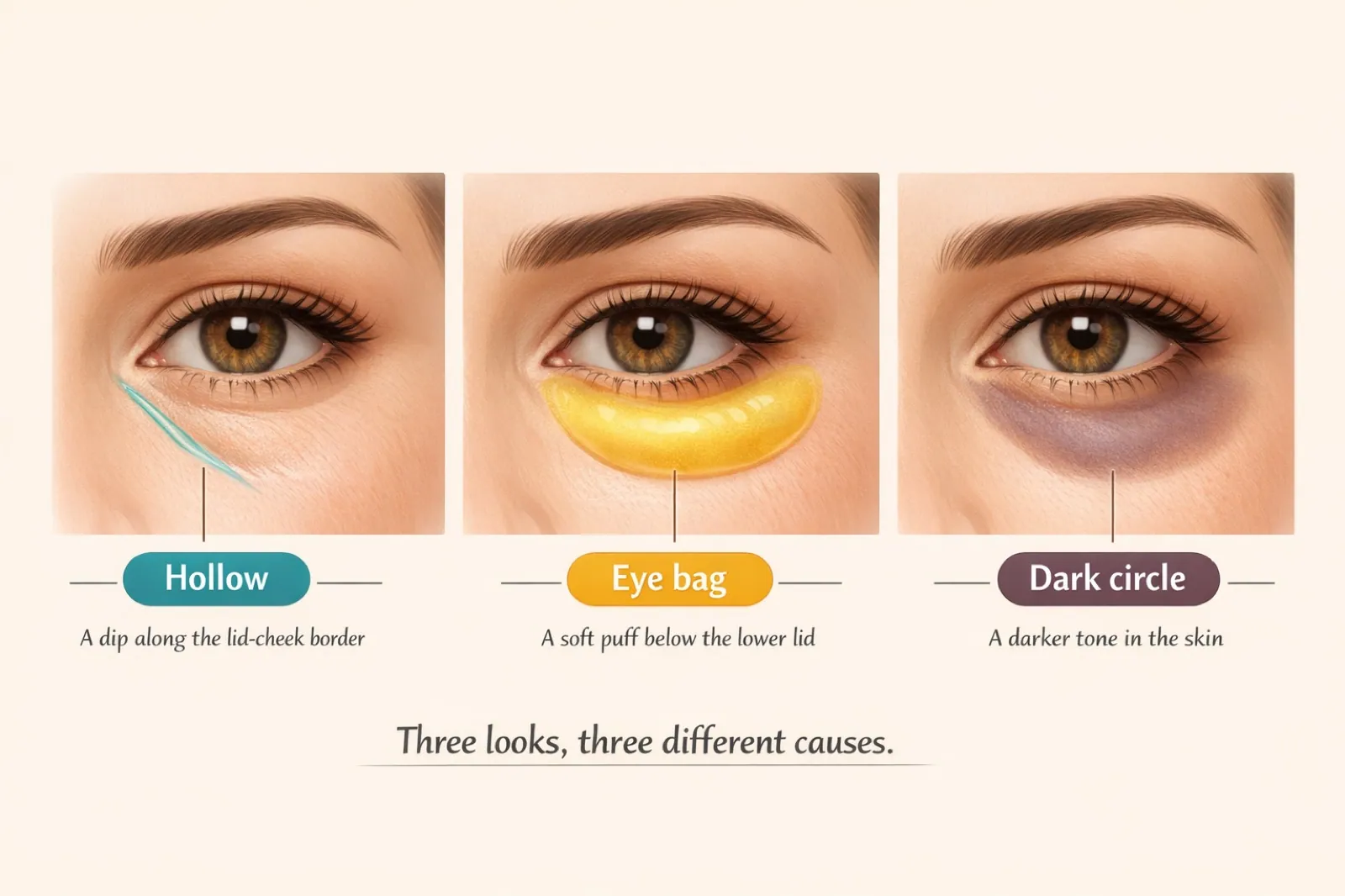
Sunken-looking under-eyes can come from three different things that often look alike: a hollow (a groove between the lower eyelid and the cheek), an eye bag (a soft bulge of fat) or a dark circle (darker skin). A hollow can also cast a shadow that looks like a dark circle, so sorting out the cause is the first step before any treatment is chosen. This article explains how the three differ, what causes each one, and what a doctor looks at first.
What do people mean by sunken under-eyes?
Most people mean that the area between the lower eyelid and the cheek looks dipped, tired or shadowed. The American Academy of Ophthalmology’s EyeWiki describes a tear trough deformity as a hollow groove between the lower eyelid and the cheekbone, running from the inner corner of the eye toward the area below the pupil (EyeWiki). It can run in families or appear with aging, and it can occur alone or together with a bulge of fat in the lower lid.
- A hollow: a dip or groove under the eye
- An eye bag: a soft puff just under the lower lid
- A dark circle: a darker tone in the skin itself
How can a hollow, an eye bag and a dark circle look alike?
They sit in the same small area, and they often appear together. A hollow can cast a shadow that looks like a dark circle, while a bulge above a hollow can make the dip look deeper. Dark circles can also come from causes that have nothing to do with a dip, such as pigment or visible blood vessels.
| What you notice | What it often is | What is usually looked at |
|---|---|---|
| A dip or groove under the eye, often with a shadow | A hollow, where volume or support under the eye is reduced | Depth and length of the groove, cheek volume, shadows |
| A soft puff just under the lower lid | An eye bag, where fat has moved forward | Fat prominence, looseness of the skin, lid position |
| A darker patch or tint on the skin itself | A dark circle, from pigment, visible blood vessels or skin changes | Skin color, blood vessels, history of eczema, allergies or eye rubbing |
What causes each one?
Each look comes from a different layer of the area, so the causes differ.
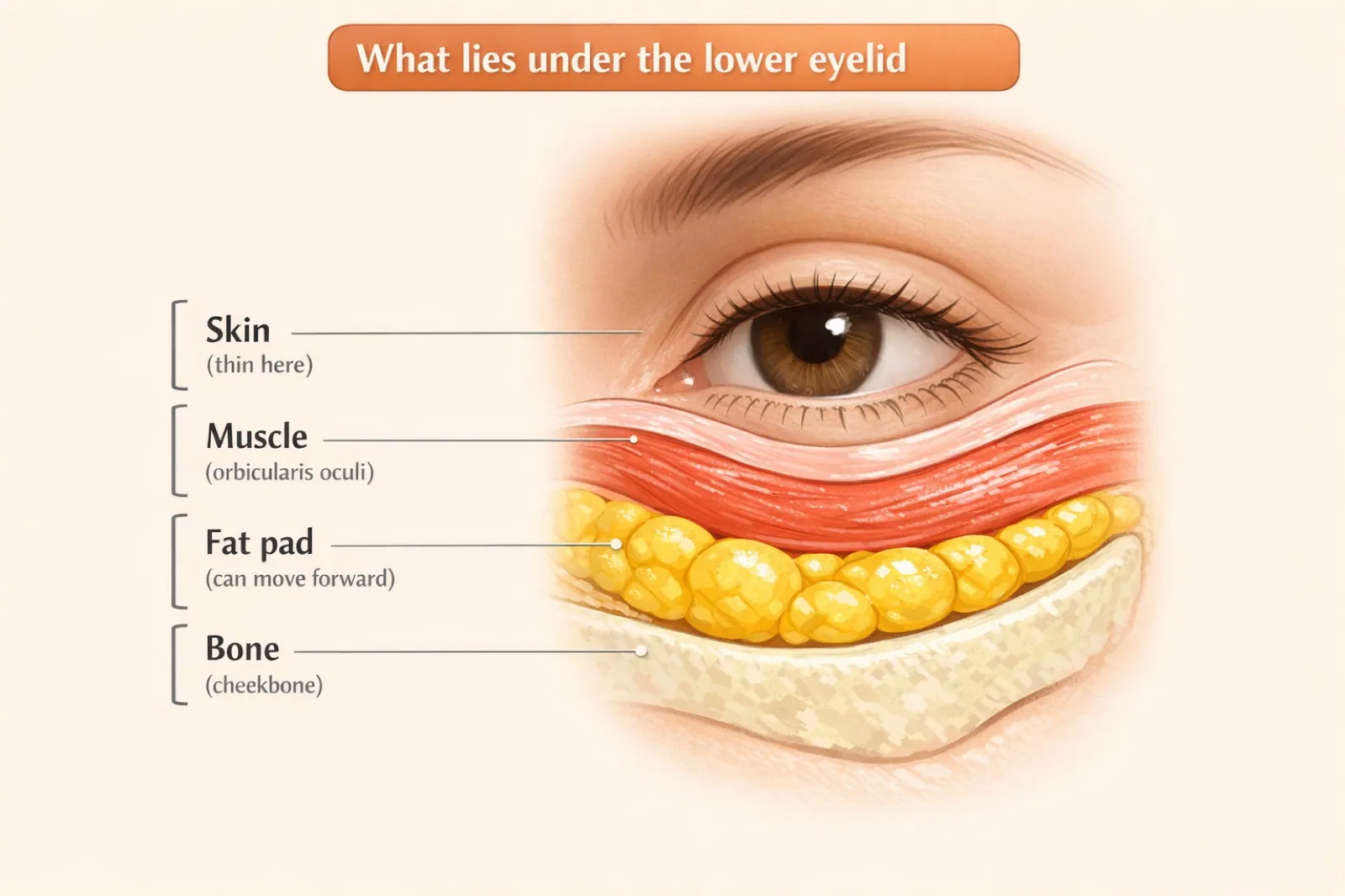
- Hollow: the tear trough ligament and the orbicularis retaining ligament hold the lower eyelid to the cheek, and the central part of the retaining ligament stretches with age. Loss of fat in the upper cheek, a less projecting cheekbone and bone loss can also deepen the groove (EyeWiki).
- Eye bag: three fat pads sit under the eye. They can move forward when the thin tissue that holds them back, the orbital septum, becomes thin or weak (EyeWiki).
- Dark circle: reviews describe dark circles as multifactorial. They can come from deep facial anatomy, soft tissue changes and the skin itself (Vrcek et al., 2016). EyeWiki adds that dark circles can have congenital, vascular or pigmentation causes, and that a hollow can cast a shadow that looks like a dark circle. Under-eye pigmentation can also follow dermatitis, allergy, sleep disturbance, nutritional deficiency or other health conditions, and it is more common in skin of color (Roberts, 2014).
Why does the cause matter before choosing any treatment?
Because the options work on different layers. A review in the Journal of Cutaneous and Aesthetic Surgery describes dark circles as multifactorial and says management can be tailored to the anatomic changes present. The options it lists range from makeup and cosmeceuticals, lasers and chemical treatments to fillers, fat transfer and surgery (Vrcek et al., 2016). For tear trough hollows, EyeWiki lists injectable fillers, fat grafting, implants and lower eyelid surgery, with lasers or peels used for skin quality. A dermatology review also encourages a full medical history and examination before treating the cosmetic side (Roberts, 2014). Which option fits you is a medical decision made after an examination, and it starts with knowing which of the three looks you have.
If an injectable is suggested, ask which product it is and what its approved purpose is in Korea. Approvals are specific to each product, and you can look up a product’s record in the Korean device register with its approval number.
How does 4ever the Cheongdam approach the under-eye area?
The skin under the eye is thin and moves with every blink and expression, so planning here is different from planning for a firmer area. At 4ever the Cheongdam in Seoul, Dr. Younghan Seo plans under-eye treatment around the thickness of the skin, the under-eye fat, the pattern of blood vessels, and the depth and amount of anything placed in the area.
Not every under-eye look suits an injection. In some cases it can lead to swelling or an unnatural look, which is why the cause is checked first.
What should a visitor from abroad plan for?
Plan to explain what you see, because the three looks need different answers.
- Photos: bring a few photos taken in normal light from the front and the side
- Your history: write down earlier injectables with dates, current medicines, allergies, eczema, and whether you rub your eyes
- The product: if an injectable is planned, ask for its name, ask to see the box and ask about its approved purpose
- A buffer: leave a few days before a wedding, a photo or a work event
- Contact details: ask how to reach the clinic if something changes after you leave Korea
What side effects should you know about?
Any injection near the eye carries risks. EyeWiki lists bruising, infection, allergic reactions, lumps (granulomas), asymmetry, swelling, movement of the product from where it was placed and, rarely, blocked blood vessels. Contact the clinic or seek medical care right away for severe pain, a change in skin color or any change in vision. A change in only one eye, or one that keeps getting worse, is also worth having examined. Whether treatment suits you is a clinical judgment your doctor makes after examining you.
Frequently asked questions
Can sleep or allergies affect dark circles?
Reviews list dermatitis, allergy, sleep disturbance and nutritional deficiency among the things that can contribute to under-eye pigmentation (Roberts, 2014). Your doctor will usually ask about them, along with your history, before suggesting anything.
Is a hollow under the eye the same as a dark circle?
Not always. A hollow can cast a shadow that looks like a dark circle, but dark circles can also come from pigment, visible blood vessels or inherited traits, which are different problems.
Are eye bags and hollows the same thing?
No. An eye bag is a bulge, usually from fat moving forward, and a hollow is a dip. They can appear together, which is why the area can look puffy and sunken at the same time.
Can filler fix dark circles?
It depends on the cause. If most of the darkness is the shadow of a hollow, it comes from the shape under the skin, which is a volume question. Darkness from pigment or visible blood vessels comes from the skin itself and is approached differently, so the cause is checked first.
Do dark circles need treatment?
It depends on the cause and on how much the look bothers you. Dark circles can be linked to conditions such as dermatitis or allergy, so a doctor can check for those first. A change in only one eye, or one that keeps getting worse, is worth having examined.
What should I bring to a consultation in Korea?
Photos of the area, a list of earlier injectables with dates, your medicines and allergies, and questions about the product and its approved purpose.
This article is general information about a treatment offered at 4ever the Cheongdam. It is not medical advice and does not replace consultation with a doctor who has examined you. Product approvals, regulations, and clinic practices change; please confirm anything that affects a decision with the clinic directly.
Sources: American Academy of Ophthalmology, EyeWiki, Tear Trough Deformity. Vrcek I, Ozgur O, Nakra T. Infraorbital dark circles: a review of the pathogenesis, evaluation and treatment. J Cutan Aesthet Surg. 2016;9(2):65-72, PubMed. Roberts WE. Periorbital hyperpigmentation: review of etiology, medical evaluation, and aesthetic treatment. J Drugs Dermatol. 2014;13(4):472-482, PubMed. Korean Ministry of Food and Drug Safety, medical device register, emedi.mfds.go.kr.