Originally published on dryounghanseo.com on November 5, 2026, while Dr. Younghan Seo practised at 4ever the Cheongdam. Clinic names and details in the text reflect that time. Dr. Seo now sees patients at L&L Clinic, Cheongdam.
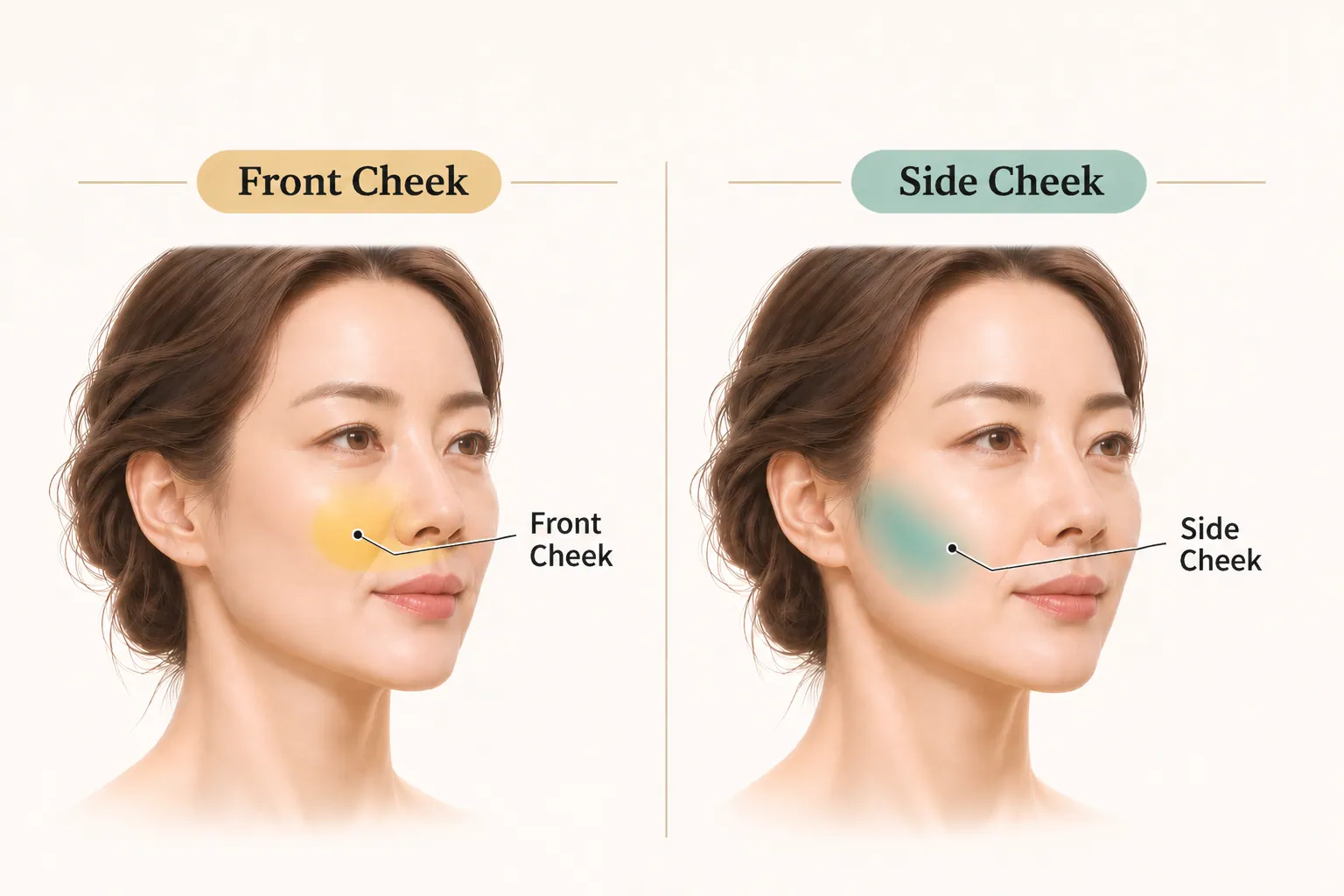
A hollow at the front of the cheek mostly shows up as a shadow, while a hollow at the side of the cheek mostly shows up as a bend in the outline of the face. Both are called cheek hollowing, but they sit in different places and change the face in different ways. That is why the location and depth of the hollow are checked first, before any injectable product is discussed. No single product fits every hollow cheek; the plan follows the face.
What is front cheek hollowing, and why does it happen?
Front cheek hollowing is a loss of fullness in the area below the cheekbone that runs toward the side of the nose. With age, the fat layer that supports this area becomes smaller, and the retaining ligaments that hold the soft tissue in place give less support. The fullness then moves downward.
When that happens, a shadow forms under the cheekbone. The nasolabial folds, the lines that run from the sides of the nose to the corners of the mouth, can look deeper. The face can look tired even after a full night’s sleep.
In some faces, the shadow does not stop at the fold. It continues down toward the corners of the mouth and forms an A-shaped shadow around the lower face.
How the retaining ligaments support the middle of the face is explained in our earlier article, What Is a Retaining Ligament Filler? A Placement Approach, Not a Product.
What is side cheek hollowing, and why can the face look narrow in the middle?
Side cheek hollowing is a loss of fullness on the outer part of the cheek, below the cheekbone. Seen from the front, the middle of the face looks narrow while the cheekbones look wide. In Korea, this shape is sometimes described as peanut-shaped.
Bone structure is sometimes the cause. In many faces, however, the soft tissue on the side of the cheek is simply thin. This shape becomes more likely when three things come together:
- the cheekbones are prominent
- the side of the cheek has little soft tissue
- the temples are flat
With age, the fat pads in this area become thinner and the ligament support weakens. The inward bend between the cheekbone and the jaw then becomes easier to see.
Why does the location of the hollow change how treatment is planned?
The location decides what kind of change the face needs. A front cheek hollow is mostly about a shadow. A side cheek hollow is mostly about an outline.
For a front cheek hollow, the plan looks at how the shadow connects to the nasolabial fold and to the area around the mouth. If the shadow has spread toward the mouth in an A shape, treating the fold alone can leave the rest of that shadow in place.
For a side cheek hollow, the plan looks at how the temple, the cheekbone, and the jawline connect. Adding volume to the side of the cheek alone, without looking at that wider line, can leave the lower face looking heavier rather than smoother.
In both cases, the area that needs support can be larger than the area that looks hollow.
What are Sculptra, Ellansé, and Juvelook, and what are they approved for in Korea?
These three products are injectables made from biodegradable polymer materials. In Korea they are regulated as medical devices by the Ministry of Food and Drug Safety (MFDS), and each approval states a specific purpose. Each product is described on its own below.
Sculptra contains poly-L-lactic acid (PLLA). In Korea it is approved under 수허 10-1161 to temporarily improve facial wrinkles in adults by injecting poly-L-lactic acid, through physical restoration. It is usually planned over about three sessions, spaced at least three to four weeks apart, and the amount placed in the first session is kept modest.
Ellansé is a polycaprolactone (PCL) injectable, not a hyaluronic acid filler. In Korea it is approved in the S and M formulations, under 수허 12-1371 and 수허 12-1372. The approved purpose is to temporarily improve facial wrinkles in adults by injecting polycaprolactone subcutaneously, through physical restoration.
Juvelook contains polylactide and hyaluronic acid. In Korea it is approved under 제허 17-972 to temporarily improve facial wrinkles in adults by injecting polylactide and hyaluronic acid subcutaneously, through physical restoration.
The prefix of each number tells you what kind of approval it is: 수허 (suheo) is an import approval, and 제허 (jeheo) is a manufacturing approval. You can search these numbers, exactly as written in Korean, on the MFDS medical device information portal.
What does Dr. Younghan Seo check before planning treatment for a hollow cheek?
At 4ever the Cheongdam in Seoul, all three products above are used, and Dr. Younghan Seo of 4ever the Cheongdam starts with the face rather than the product. Before a product is chosen, he checks five things:
- Location — whether the hollow is a shadow at the front of the cheek or a bend in the outline at the side
- Extent — whether a wide area has lost fullness in general, or one spot has become deeply hollow
- Sagging — whether the tissue has also moved downward, and whether adding volume alone can address what is seen
- Timing — whether you want to see a change soon after the visit, or prefer a change that builds slowly
- Treatment history — which products have been placed before, and where
Extent, sagging, and treatment history can only be judged by examining the face in person.
Because these products cannot simply be dissolved after injection, Dr. Seo sets the plan at the start: which layer, how much, and over how many sessions. For a side cheek hollow, he decides where to support and where to refine within the line that runs from the temple through the cheekbone to the jawline. For a front cheek hollow that has spread toward the mouth, he plans the fold and the area around the mouth together.
The Ellansé Heartline Solution is an injection method designed around the retaining ligaments. It has a Contouring Code for shaping the outline and a Lifting Code, placed in small amounts at deep support points near the ligaments. He has used this approach in his practice since it was first introduced. Dr. Younghan Seo is a Key Doctor for Sinclair, the company behind Ellansé — a title the company uses for physicians who teach and present on its products, not a government qualification or an endorsement of treatment results.
Whether this treatment suits you is a clinical judgment your doctor makes after examining you.
What should you expect after treatment, and can it be reversed?
Swelling, bruising, and redness at the injection sites are commonly reported after facial injectables. Nodules or lumps under the skin have been reported with PLLA, PCL, and polylactide injectables. As with any injection into the face, there is also a rare risk of a vascular complication, which needs prompt attention from the treating clinic.
Hyaluronic acid fillers can be dissolved with an enzyme called hyaluronidase. The products in this article cannot be reversed that simply. This is the main reason the placement, amount, and number of sessions are planned carefully before the first injection.
Tell the clinic about any medication you take and about any earlier treatment in the same area.
Frequently asked questions
Is a hollow side cheek caused by my bones?
Sometimes, but not always. In many faces the side of the cheek looks hollow because the soft tissue there is thin, especially when the cheekbones are prominent and the temples are flat. Aging can make this more visible as the fat pads thin and ligament support weakens. An in-person exam is needed to tell which applies to you.
Will filling the side of my cheek make my face look bigger?
It can, if volume is added to the side of the cheek alone. A side cheek hollow is part of a line that runs from the temple through the cheekbone to the jawline. When that line is looked at as a whole, the plan decides where to add support and where not to, so the lower face is not left looking heavy.
I already had filler in my cheeks. Does that change the plan?
Yes. Which products were placed before, where, and how long ago all affect what is added next and where. Bring any records you have of earlier treatments, including product names if you know them.
How many sessions will I need, and does that matter if I am visiting Korea?
It depends on the product and on how much change is planned. Some products, such as Sculptra, are usually planned over several sessions spaced weeks apart. If you are visiting Korea from abroad, ask at your first consultation how many visits the plan needs and how far apart they are, so you can arrange your stay or a return trip.
Can the result be dissolved if I do not like it?
Not in the way hyaluronic acid filler can. Hyaluronic acid filler can be dissolved with an enzyme, but Sculptra, Ellansé, and Juvelook cannot be removed that simply. This is why the plan is set carefully at the start.
Which product is used for a front cheek hollow?
There is no single product for every front cheek hollow. The choice depends on how wide and deep the hollow is, whether the shadow continues toward the mouth, whether the tissue has also descended, and what has been placed before. These are assessed at the consultation.
This article is general information about a treatment offered at 4ever the Cheongdam. It is not medical advice and does not replace consultation with a doctor who has examined you. Product approvals, regulations, and clinic practices change; please confirm anything that affects a decision with the clinic directly.