Originally published on dryounghanseo.com on November 10, 2026, while Dr. Younghan Seo practised at 4ever the Cheongdam. Clinic names and details in the text reflect that time. Dr. Seo now sees patients at L&L Clinic, Cheongdam.
Often yes, if it is a hyaluronic acid (HA) filler. HA filler can be broken down with an enzyme called hyaluronidase, and it does not matter which clinic or which country the filler was placed in. What matters is what the filler is made of, where it sits and how much of it remains. Fillers made of other materials do not respond to the enzyme, so knowing what you had is the first step.
What decides whether a filler can be dissolved?
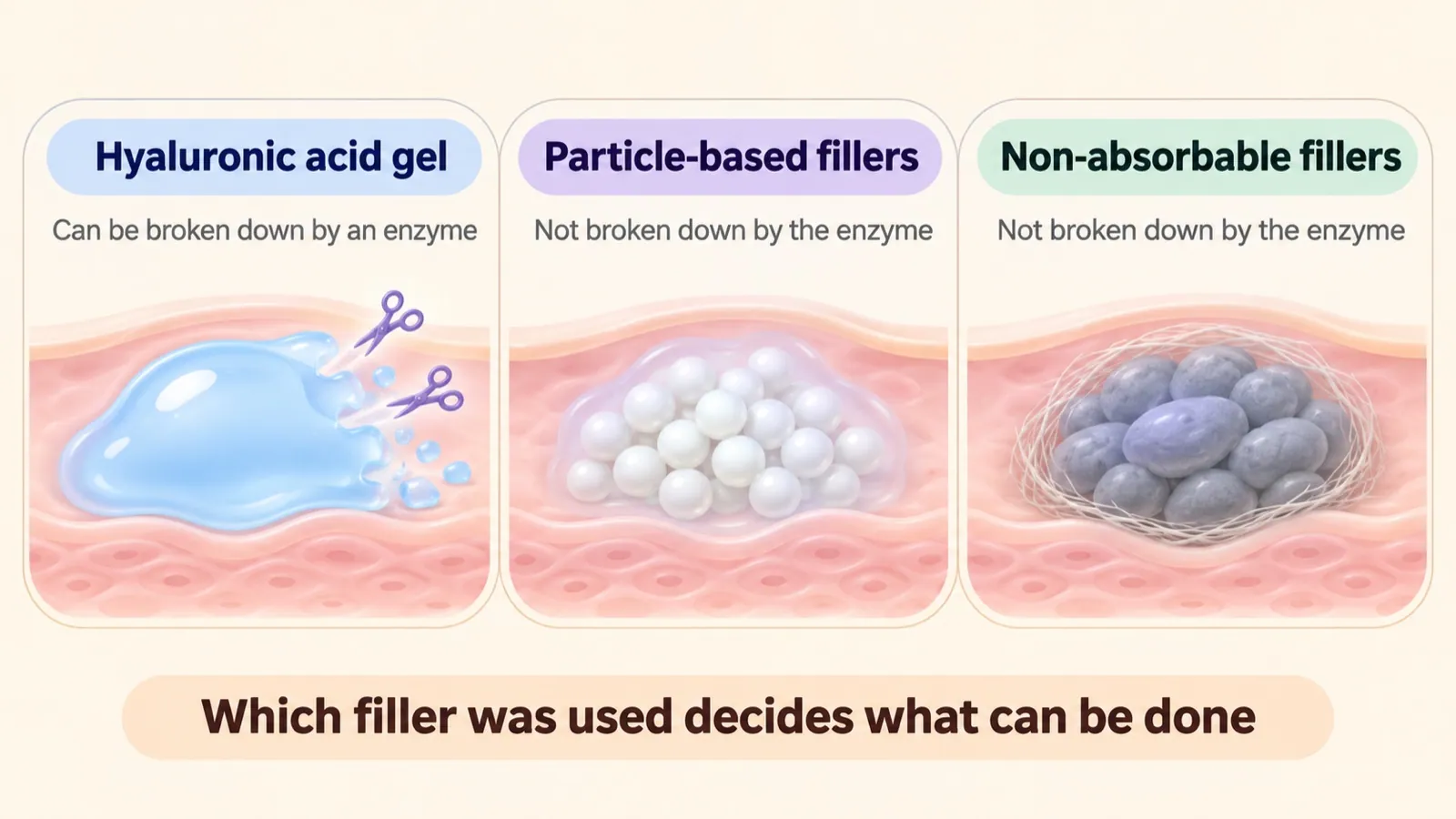
The material decides it. Hyaluronidase is an enzyme that breaks down hyaluronic acid, and guidance for aesthetic medicine describes its widespread use to dissolve HA-based dermal fillers (Murray et al., 2021). It works on HA, not on other filler materials.
- The material: HA filler can be broken down by the enzyme; other materials cannot
- The location: where the filler sits and at what depth affects how the doctor plans the injection points
- The amount: how much filler remains, and whether it was placed in one session or built up over several
- The product: some HA fillers are more strongly cross-linked or have larger gel particles, which can make them slower to break down
Where the filler was placed does not change what it is made of. HA filler from a clinic in another city or another country is still HA, and the same principle applies to it.
Which fillers can be dissolved, and which cannot?
Fillers fall into a few groups by material, and only one of them is broken down by hyaluronidase. A review of dermal filler adverse events groups fillers into biodegradable and non-biodegradable materials (Funt and Pavicic, 2013).
- Hyaluronic acid (HA) fillers: the most widely used biodegradable fillers. They can be broken down with hyaluronidase.
- Particle-based fillers: materials such as poly-L-lactic acid (PLLA) and calcium hydroxylapatite (CaHA). They are biodegradable, but hyaluronidase does not break them down. Some products combine particles with an HA gel. Hyaluronidase acts on the hyaluronic acid, so it does not remove the particles.
- Non-absorbable fillers: materials such as polymethylmethacrylate (PMMA) microspheres, polyacrylamide gel and silicone. The body does not absorb them, and the same review notes that their complications can be more long-lasting and difficult to treat.
For problems with non-HA fillers, the review describes other approaches, such as steroid treatment, laser treatment or removal of the material, depending on the problem. These are decided case by case after an examination.
The review also notes that HA fillers that are less susceptible to hyaluronidase, because of a high degree of cross-linking or a large gel particle size, may need more than one treatment (Funt and Pavicic, 2013).
Why does the record of your earlier treatment matter?
Because the doctor cannot tell what a filler is made of just by looking at the face. If the record says it was an HA filler, dissolving is an option to discuss. If the record is missing, the doctor has less to go on and may need to check the area first.
- Product name: the brand and product, as written on the box or on a card from the clinic
- Material: whether it was HA or another material, if the clinic told you
- Area and amount: which part of the face was treated and roughly how much was used
- Date: when each treatment was done, including any touch-ups
- Country and clinic: where it was done, which helps if a product is sold under a different name in Korea
Product names differ between countries, so the same filler can be sold under another name in Korea. A photo of the box, the treatment card or a message from the clinic that treated you is often enough to identify the product.
If you do not know what you had, say so at the consultation. Guessing that a filler is HA when it is not would mean the enzyme does nothing to it.
Can filler still be there years after the treatment?
Yes. HA filler can stay in the tissue much longer than many people expect. An MRI review of 33 patients who had HA filler in the mid-face found filler in all of them, with none showing complete dissipation over a 2-year period, and the study reported HA lasting up to 15 years after injection (Master et al., 2024).
This matters if you are planning new treatment in an area that was treated before. Filler that you thought had gone may still be there, and it can affect how the area looks and how new treatment is planned.
Ultrasound is one way to look for it. A 2025 review of 11 studies concluded that ultrasound helps with mapping blood vessels, detecting filler already in the tissue and identifying complications (Almushayt et al., 2025). A 2025 case report described three patients whose nasal bridge had widened years after a single HA injection; ultrasound confirmed the remaining filler and was used to guide the hyaluronidase injections (Lau et al., 2025).
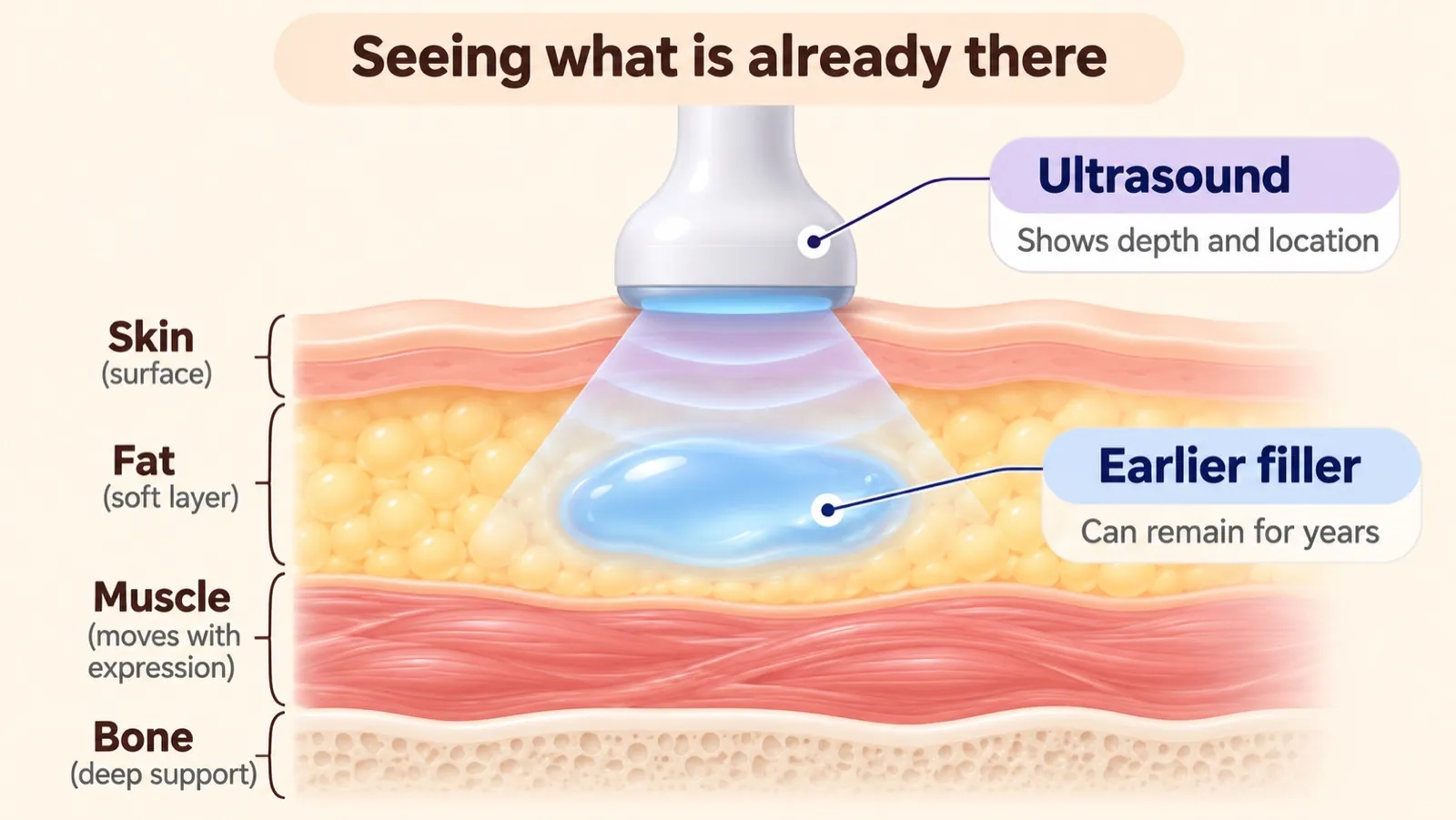
- Location: which layer the filler sits in
- Depth: how far below the skin it is
- Spread: whether it stays in one place or has spread over a wider area
- Nearby vessels: where blood vessels run around it
How does 4ever the Cheongdam approach filler from an earlier treatment?
At 4ever the Cheongdam in Seoul, a consultation with Dr. Younghan Seo starts with diagnosis, and that includes a review of your previous treatment history along with your skin condition and the change you are looking for, as described in the clinic’s profile article.
Ultrasound is used at the clinic when retaining ligament filler is injected, and it can show whether filler from an earlier treatment is still in the area, as explained in an earlier article on ultrasound before filler. When earlier filler is a concern, the location, depth and spread of what remains are checked before a plan to dissolve it is made.
Whether dissolving is the right step for you, and how it is planned, is a clinical judgment your doctor makes after examining you.
What should a visitor from abroad plan for?
Plan to bring your records and to leave time after the visit. Dissolving may take more than one session, and the area needs to be checked again afterward.
- Records: the product name, the date, the area treated and the clinic, ideally with a photo of the box or the treatment card
- Allergies: tell the clinic about any allergy, especially to bee or wasp stings
- Medicines: a list of what you take, including blood thinners and supplements
- Time in Seoul: ask the clinic how long to allow before a follow-up check, since more than one session may be needed
- New filler: if you want new filler after dissolving, ask when it can be planned; it is decided after the area has been checked again
- Language: let the clinic know your preferred language when you book
What side effects should you know about?
Hyaluronidase is a drug that is injected, so it has its own risks. Guidance on its use in aesthetic medicine discusses allergic reactions and notes that a history of allergy to wasp and bee stings increases the risk of allergy to hyaluronidase. It also discusses skin testing for allergy (Murray et al., 2021).
- At the injection points: swelling, redness, bruising and tenderness can occur, as with any facial injection
- Allergic reaction: tell the clinic about any allergy, including to stings, before treatment
- Changes after dissolving: the area can look different once the filler is gone, and swelling can make it hard to judge the result at first
HA filler can occasionally block a blood vessel, and hyaluronidase is also used urgently in that situation; a 2025 review found that early treatment, within 6 hours, was linked to better outcomes (Alhusain et al., 2025). If you have severe pain, a change in skin color or pale skin near a filler site, contact the clinic or seek medical care right away.
Frequently asked questions
Can filler I had in another country be dissolved in Korea?
If it is an HA filler, the same enzyme can be used wherever the filler was placed. Bring the product name, the date and the area treated so the doctor knows what was used.
I do not know which filler I had. Can it still be dissolved?
Possibly, but the doctor has less to go on. Ask the clinic that treated you for the product name, look for the box or the treatment card, and say at the consultation that you are not sure. The area may need to be checked, for example with ultrasound, before a plan is made.
Will one session remove all of my filler?
Not always. A review notes that HA fillers that are highly cross-linked or have large gel particles may need more than one treatment, and swelling after the first session can make the result hard to judge at first.
Can filler that is several years old still be dissolved?
HA filler can remain in the tissue for years. An MRI review found HA filler in all 33 patients it studied and reported HA lasting up to 15 years after injection (Master et al., 2024). If it is still there and it is HA, the enzyme can work on it.
I am allergic to bee stings. Can I have filler dissolved?
Tell the clinic before treatment. Guidance on hyaluronidase notes that allergy to wasp and bee stings increases the risk of allergy to the enzyme, and it discusses skin testing for allergy.
Can I have new filler after my old filler is dissolved?
Ask at the consultation. When new filler can be planned is decided after the area has been checked again once the swelling has settled.
This article is general information about a treatment offered at 4ever the Cheongdam. It is not medical advice and does not replace consultation with a doctor who has examined you. Product approvals, regulations, and clinic practices change; please confirm anything that affects a decision with the clinic directly.
Sources: Murray G, Convery C, Walker L, Davies E. Guideline for the safe use of hyaluronidase in aesthetic medicine, including modified high-dose protocol. J Clin Aesthet Dermatol. 2021;14(8):E69-E75, PubMed. Funt D, Pavicic T. Dermal fillers in aesthetics: an overview of adverse events and treatment approaches. Clin Cosmet Investig Dermatol. 2013;6:295-316, PubMed. Master M, Azizeddin A, Master V. Hyaluronic acid filler longevity in the mid-face: a review of 33 magnetic resonance imaging studies. Plast Reconstr Surg Glob Open. 2024;12(7):e5934, PubMed. Almushayt SJ, et al. The role of ultrasound in facial hyaluronic acid dermal filler injections: a review article. Clin Imaging. 2025;119:110413, PubMed. Lau E, et al. Persistent HA fillers and nasal broadening: role of ultrasound in managing “Avatar Nose”. J Craniofac Surg. 2025, PubMed. Alhusain AM, et al. Hyaluronidase protocol in management of hyaluronic acid filler-related vascular complications: a systematic review and meta-analysis. Aesthetic Plast Surg. 2026;50(6):2300-2317, PubMed.